Category: Parents

2025 Rabbi Isaac Mayefsky Memorial Parenting Lecture Recap

From Burden to Blessing: The Power of Gratitude

Presented by Rabbi Reuven Brand

Last Motzaei Shabbos, Rabbi Reuven Brand presented at the 39th Annual Rabbi Isaac Mayefsky Memorial Lecture emphasizing that the topic of gratitude is essential for parenting and living. He started with a statement by Chazal that stresses that there is a centrality of saying thank you for the spiritual person. Citing examples from the Torah and great Rabbis, Rabbi Brand explained that expressing gratitude is a key component of life. As an example, he told of Rav Gustman who tended the garden of his yeshiva as a show of hakoras hatov for the plants that saved him when he lived in the forest during the Holocaust and ate shrubs in order to live.

Why is hakoras hatov such a big deal? The Chovos Halevovos explains that it is a bedrock since Hashem gives us everything and we serve Him. Therefore, the purpose of creation is to express gratitude for all that we have.

If you were asked, what is the most important aspect of a person’s emotional growth, mental health challenges would certainly be on the list. Dr. Abraham J. Twersky, the noted psychiatrist and author of the book, Positive Parenting: Developing Your Child’s Potential, spent his life’s work on the theme of self-esteem and a healthy self-concept. He felt that the two most important aspects of this theme are self-efficacy = I’m OK, and self-respect = I’m worthy of love and happiness. To develop a healthy self-concept in ourselves and our children requires people to tap into their spiritual self-worth. This is the foundation of health and life.

Part of this idea is gratitude. Some people have a difficult time saying thank you. Why? When one says: מודה אני – he is saying “I thank” and also “I admit.” These imply indebtedness and dependence and for some people this is hard to do. It is like saying, “I needed your help.” Obviously, that person’s self-worth is not where it should be.

Dr. Twersky says it is exactly the opposite. Every human being needs to have a healthy dependence, and this starts at birth. Recognizing I am dependent means I am comfortable being human. Thus, a person comfortable saying thank you has a healthy self-confidence and understands he is a healthy human being.

Rabbi Lord Jonathan Sacks wrote, “Gratitude encourages the savoring of positive experiences. It bolsters feelings of self-worth.” (Morality p.112) He published an essay on the “Power of Gratitude (Thanksgiving).” If we can say thank you, I need you, I appreciate you, then healthy lives and a sense of community will happen naturally.

The Mishna Bikurim (3: 2-4) describes the farmer who brings his first fruits to Jerusalem. However, many people were part of this process. The ceremony involved a parade, many community members who contributed those things that made sense for them to bring, music, a procession, and a huge parade. The farmer was in essence saying thank you to Hashem. The farmer could have said, “I nurtured, I harvested, etc.” Instead, he thanks Hashem for all that he received through his toil and efforts. That farmer is a healthy person!

How can we practice gratitude? There are two general areas:

בין אדם למקום (Between man and Hashem)

ברכות – “מה ה’ אלוקיך דורש מעמך” (דברים י:יב)  חייב אדם לברך בכל יום מאה ברכות  -1

Saying blessings – What does Hashem want from you? (Deuteronomy 10:12) A man must make 100 brochos a day.

Brochos are an important form of expressing gratitude. Chazal explain that this posuk hints at the number 100 from the word מה by adding the letter alef to that word. Thus, the posuk is saying that people should recite 100 brochos every day as an expression of gratitude to Hashem. Lech L’cha = 100 in gematria to remind us of this posuk and teaches us that our journey everyday is to express gratitude to Hashem, and habituation is the way to make this part of our nature.

 2 – תפילה – Prayer

Davening is a way of expressing gratitude as well. The Rambam asks – why when the chazan says מודים so does the congregation? He answers – because the chazan cannot deputize someone else to say thank you to someone else, especially Hashem.

בין אדם לחברו (Between man and his fellow man) 

1 – One can thank a rebbe/teacher for a shiur/class.

2 – One can thank students or children for their behaviors, actions, and things they bring into the home. 

Rabbi Brand concluded by stating gratitude is a life-changing midah changing the world around us and nurturing our basic sense of self. He encouraged all present to enhance the practice of expressing gratitude to Hashem and to others in their lives.

2025 Rabbi Isaac Mayefsky Memorial Parenting Lecture

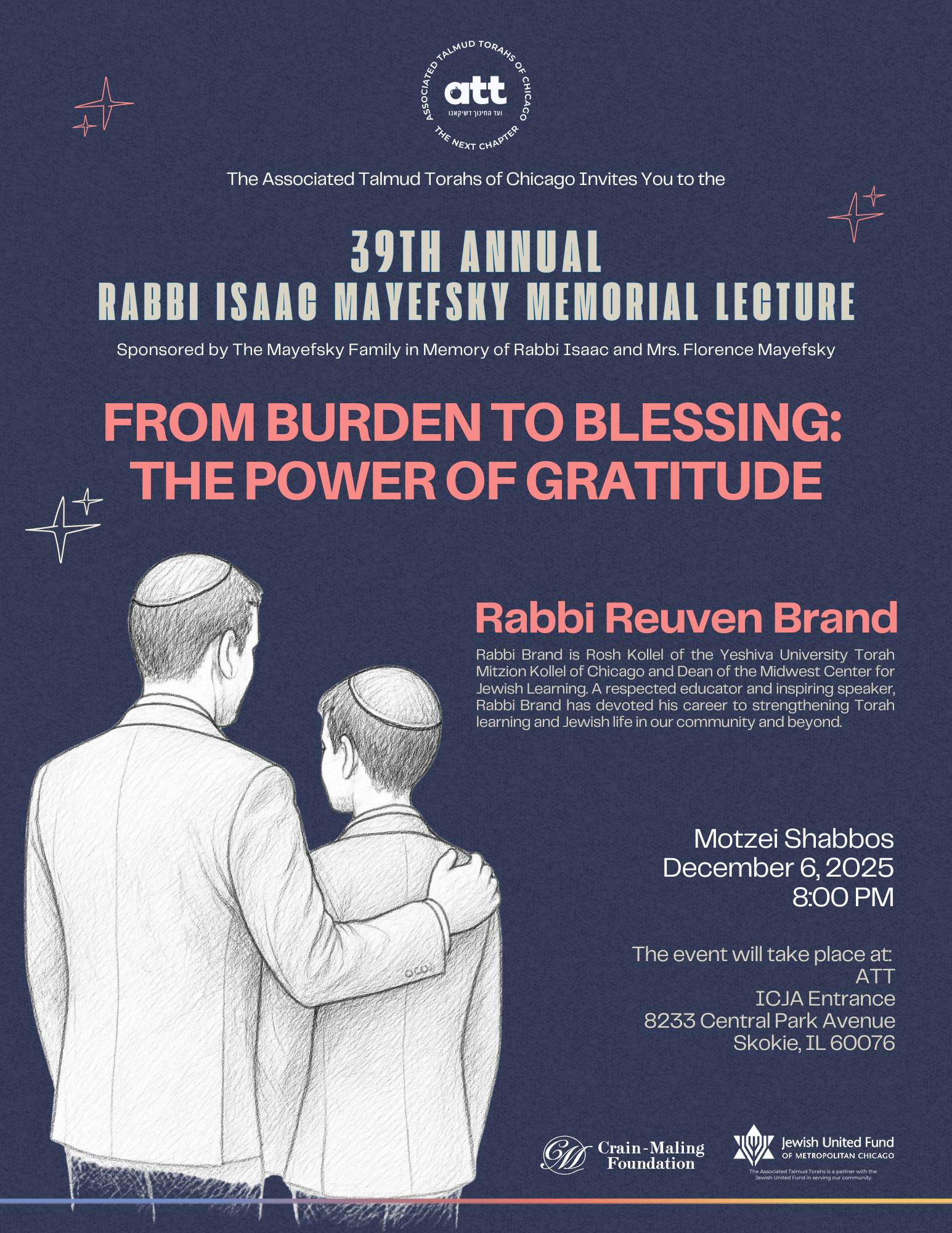
Raising children in today’s world is challenging, and supportive guidance can be truly valuable. Join us for the ATT’s 39th Annual Rabbi Isaac Mayefsky Memorial Parenting Lecture on Motzei Shabbos, December 6, 2025, at 8:00 pm at the ATT, ICJA Entrance, 8233 Central Park Ave, Skokie. The evening will feature Rabbi Reuven Brand, Rosh Kollel of the Yeshiva University Torah Mitzion Kollel of Chicago and Dean of the Midwest Center for Jewish Learning, speaking on From Burden to Blessing: The Power of Gratitude. 

Admission is free.

To view flyer, click here.

For details, call 773-973-2828.

Being a Positive influence on Our Teenage Children’s Growth: Balancing Parental Authority with Healthy Autonomy

Last Motzei Shabbos, close to 100 attendees joined the ATT for their 38th Annual Rabbi Isaac Mayefsky Memorial Lecture featuring the captivating speaker and author, Rabbi Moshe Revah, Rosh HaYeshiva at Bais HaMidrash LaTorah/HTC, Rav of Ohel Tefillah. His presentation, “Being a Positive influence on Our Teenage Children’s Growth: Balancing Parental Authority with Healthy Autonomy”, focused on strategies for effective parenting.

First, Rabbi Revah noted that to understand what strategies would be helpful, one needs to understand the dynamics of being a teenager. He described the stages of childhood. A baby starts as part of the mother, is born into a child-oriented world, and then enters a parent-oriented relationship. At the age of 12/13, the next process occurs – one of נערות (an awakening), i.e. adolescence. This stage lasts for about 7-8 years and during this time the teen forges his/her own path, a path of passion, dreams, energy, etc.  Unfortunately, these traits are accompanied by a lack of wisdom, maturity, experience, and hormonal transitions. It is the parents’ job to channel this energy into creating an amazing independent person.

Why is this information important? Because it teaches parents what to expect from their teens. If parents know what to expect, they will react differently and relate in a more productive way.

His suggestions to help parents and teachers raise independent teens and keep them focused on Torah values included:

1. Listen to your teenager – their hopes and their fears. If you give them the opportunity to share, they will share. Spend time with them, at least 30 minutes per week.

2. Treat them with respect. This shows a child that the parent values him/her while the dynamic is changing as they start to exert their independence.

3. Don’t expect the teen to always be reasonable. Nevertheless, express your proper values and voice of reason. These lessons are being heard and will eventually shape who your teen becomes. Do the best you can. and provide a safety net of love even if your words do not appear to be heard.

4. Your job is to motivate, not control. Be a macro manager, as opposed to a micromanager. Allow freedom of growth and making mistakes. This will breed competence, responsibility, loyalty, and trust.

5. Allow and encourage individuality – educate your child on “his/her” path – not yours. חנוך לנער על פי דרכו, not yours. Don’t take credit for your child’s success.

6. Let your teen be part of the rule-making. Allow your teen to have choices in their part of the family dynamic.

7. Learn how to argue properly – keep the tone respectful, praise the positive, and do not engage with anger. Stop the conversation if it is out of control. Enforce a rule pleasantly – “I expect more from you,” “I understand you want this,” “I appreciate how you explained your points,” “This is the bottom line…” If it’s something the child will learn on their own from natural consequences, don’t give advice about the issue. Remember, no matter what you do, you can’t guarantee the results. Expect failures – this is natural in the growth process for all of us. You can always work on repairing relationships.

8. If a teen wants money/material possessions, discuss with him/her what the responsible needs of a teen are. You can divide the expenses with a baseline provided by parents, an allowance to teach budgeting, and the knowledge that this is a shared issue.

9. Explain the nuances of smoking, alcohol, marijuana, etc. Don’t make these things available but be aware of peer pressure. Treat your child like an adult and give him/her initial trust to make the right choices/decisions.

10. Recognize the opportunity to become better in middos yourself, especially in how you react.

11. Daven, daven, daven!

Rabbi Revah emphasized that raising children, especially a teenager, is one of the hardest and most rewarding things we can do.  The goal is to raise our children to be another link in the chain of Hashem’s mesorah – tradition. They are independent beings, not clones of ourselves.

This lecture is part of the ATT’s expanded program designed to address the challenges of creative teaching and rewarding parenting.  Over the years, it has become an excellent resource for parents and teachers of children of all ages.
2024 Rabbi Isaac Mayefsky Memorial Parenting Lecture

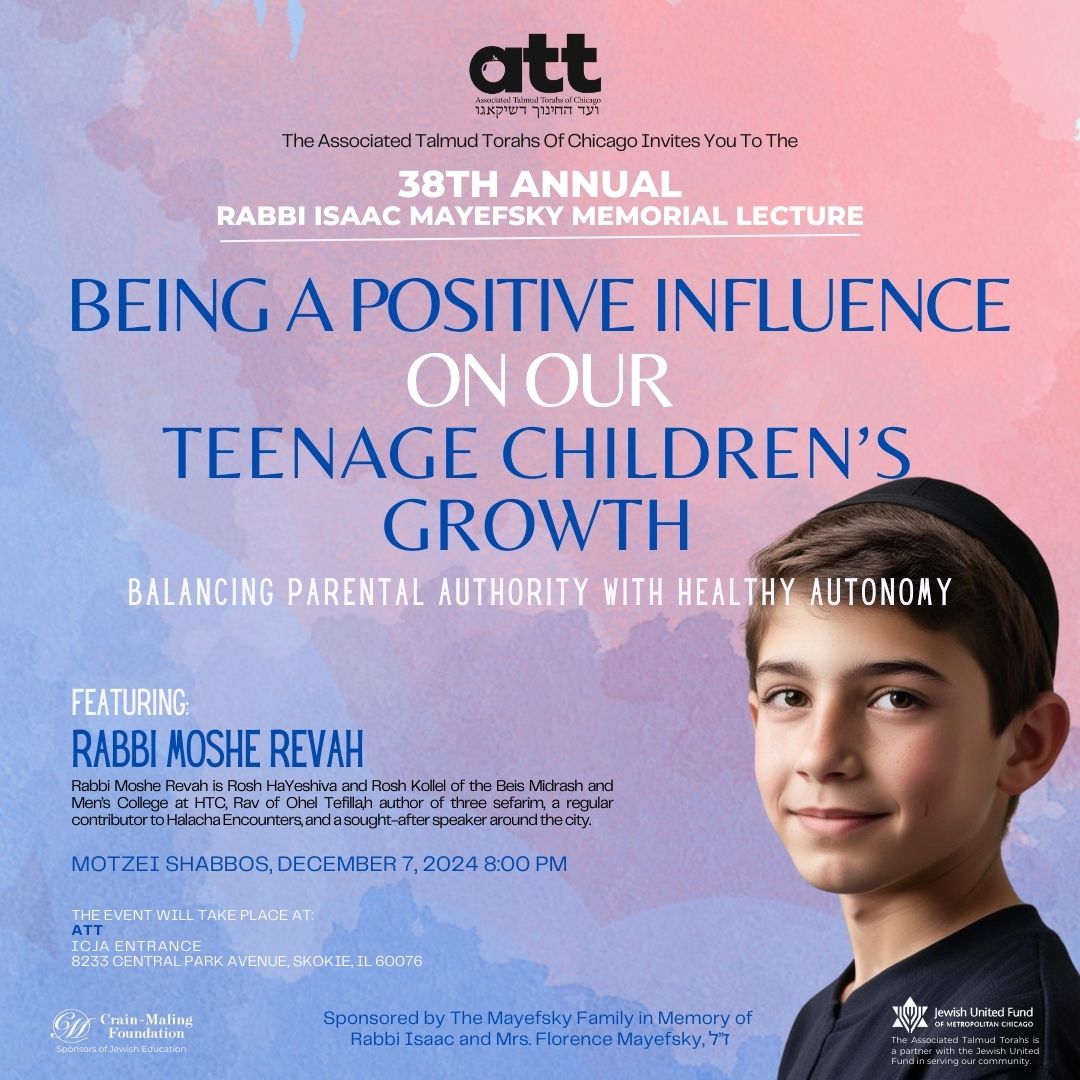
Raising children in today’s world! Looking for guidance? Attend the ATT’s 38th Annual Rabbi Isaac Mayefsky Memorial Parenting Lecture on Motzei Shabbos, December 7, 2024, 8:00 pm at ATT, ICJA Entrance, 8233 Central Park Ave, Skokie featuring Rabbi Moshe Revah, Rosh HaYeshiva at HTC, Rav at Ohel Tefillah, speaker, and author. He will explore the topic Being a Positive Influence on our Teenage Children’s Growth: Balancing Parental Authority with Healthy Autonomy.Admission: Free.

2021 Rabbi Isaac Mayefsky Memorial Lecture

Close to 200 parents and teachers of school-age children joined the Associated Talmud Torahs on Motzaei Shabbos, December 11, 2021, to attend the 35th Annual Rabbi Isaac Mayefsky Memorial Lecture.  This annual parenting program featured the captivating speaker and educator, Rabbi Jonathan Rietti.

The presentation, Raising Resilient Children in a Confusing World, focused on strategies for effective parenting. Rabbi Rietti provided many practical suggestions to help parents and teachers as they teach children how to bounce back when faced with adversity. He presented the following ideas:

Children are created B’Tzelem Elokim and from conception, they have been endowed with unbelievable growth powers as they develop into adulthood. Children and “successful” adults are inherently resilient – no matter how often they fall, they try again and again and again.

Life is experienced in one’s brain. The world happens through us – not to us. Thus, thought is extremely powerful. Even our emotions are impacted by our thoughts. Humans “feel” their thoughts.

What are some thoughts/strategies that help us build resilience?

—– The sun is always shining – even when it is a cloudy day. A trip in an airplane above the clouds proves that.

—– When the mind is cluttered with concerns, one cannot see with clarity. A snow globe is a perfect example of this. Try to let the “snow” settle and consider your next thought.

—– The media manipulates the minds of adults and children and entices both to be “free” when really, the encouragement is to be out of self-control. True freedom is being in control of one’s life.

—– Smartphones and social media always present the option to explore or ignore what is being projected. You can choose to ignore.

—– You can’t stop thinking but you can always control the next thought. You are born with a filter – your mind – and you are always one thought away from changing your mind. You cannot have two thoughts simultaneously.

  • Negative thoughts are draining.
  • Letting go of negativity allows one to start again.
  • Pick out the weeds of your thought garden so that the positivity is not overtaken by the negativity.

—– Bad news gets our attention because it’s news. Focus, instead, on the good news that happens daily. Resilience = paying attention to G-d’s reality.

—– We are role models for our children.

  • Influence your children by staying in control when faced with adversity.
  • V’Shenantam L’Vanecha – “chew” (from the root of the word for tooth – shein) and savor the taste of what you experience in front of your children. How you live through challenges in front of your children will make an impression on them.
  • V’Dibarta Bam – It is never too late to build a relationship with our children. Speak with them – ask them questions. Keep the dialogue open and bring out the resilience that is innate to them as humans. The most powerful place to do this is face to face in the home environment. Do so with simcha and passion.

—– G-d has a plan for us – our history proves this. Though we have suffered many calamities as Jews, we are still here, and this proves the resilience that we have from birth.

This lecture is part of the ATT’s expanded program designed to address the challenges of creative teaching and rewarding parenting.   Over the years, it has become an excellent resource for parents and teachers of children of all ages.   
Rabbi Isaac Mayefsky was a gifted educator who, in the course of more than 40 years of communal service, developed many key programs within the Associated Talmud Torahs, including the Russian Transitional Program and the Dr. Oscar A. & Bernice Novick PTACH Special Education Program.


2021 Mayefsky Memorial Parenting Lecture

The community is invited to join the ATT for the 35th Annual Rabbi Isaac Mayefsky Memorial Parenting Lecture on Motzoei Shabbos, December 11, 2021 at 8:00PM at the Associated Talmud Torahs, (ICJA Entrance – 8233 Central Park Avenue) in Skokie. The theme of this year’s lecture will be “Raising Resilient Children in a Confusing World” and will be presented by Rabbi Jonathan Rietti, captivating speaker and renowned educator.  Rabbi Rietti will address how to enhance relationships with children and how to build a child’s resilience in our ever-changing world. He will explore the Torah’s timeless and successful parenting prescription. The program will provide parents with skills that can be applied to children of all ages. Admission is free.

To see the brochure, click here.

For more information, contact the Associated Talmud Torahs at 773-973-2828.

Mayefsky Memorial Parenting Lecture

The community is invited to join the ATT for the 33rd Annual Rabbi Isaac Mayefsky Memorial Parenting Lecture on Motzoei Shabbos, December 14, 2019 at 8:00PM at the Associated Talmud Torahs, (ICJA Entrance – 8233 Central Park Avenue) in Skokie. The theme of this year’s lecture will be “Inspiring Our Children in 2020” and will be presented by Rabbi Levi Feldman, captivating speaker, educator and coach who is passionate that every child thrives and reaches his/her maximum potential.  Rabbi Feldman will address how to enhance relationships with children, how to build a child’s confidence and increase cooperation. The program will provide parents with skills to inspire one’s child to go the extra mile – skills that can be applied to children of all ages. Admission is free.
To see the brochure, click here.

For more information, contact the Associated Talmud Torahs at 773-973-2828.