If there’s one lesson to take from 2020, it’s that the job of a teacher extends beyond just teaching. That mental health can affect student learning is well-known, but this year it’s that much greater.
Fortunately for the ATT, in collaboration with Walder Education, Angela Searcy, Ed.D recently presented to ATT teachers how to implement social and emotional learning strategies to help students thrive in learning despite the extraordinary challenges of learning in a pandemic.
Social and emotional learning (SEL) is the process through which children and adults understand and manage emotions, set and achieve positive goals, feel and show empathy for others, establish and maintain positive relationships, and make responsible decisions.
Helping students thrive
For some teachers, being mindful of social and emotional learning may come naturally. If that’s not yet a strength, there are many tools and strategies teachers can implement to ensure students’ emotions aren’t standing in the way of learning.
A systemic approach to social and emotional learning intentionally cultivates caring, participatory, and evidence-based practices to actively involve all students in their social, emotional and academic growth.
In her book Push Past It! A Positive Approach to Challenging Classroom Behaviors, Dr. Searcy shares examples and explains where SEL fits within the mental health continuum. In her presentation, Dr. Searcy reviewed steps that support good behavior planning, outlined tools to help educators MATCH a strategy to their unique students and program, and shared what to expect at different phases of implementation.
Implementing SEL techniques
It takes time to master any new teaching strategy, so a great starting point is a visit to the National Center for Pyramid Models Innovation (NCPMI)’s Practical Strategies for Implementing the Pyramid Model for social and emotional learning idea inspiration.
Following are strategies to easily and effectively implement SEL into lesson plans.
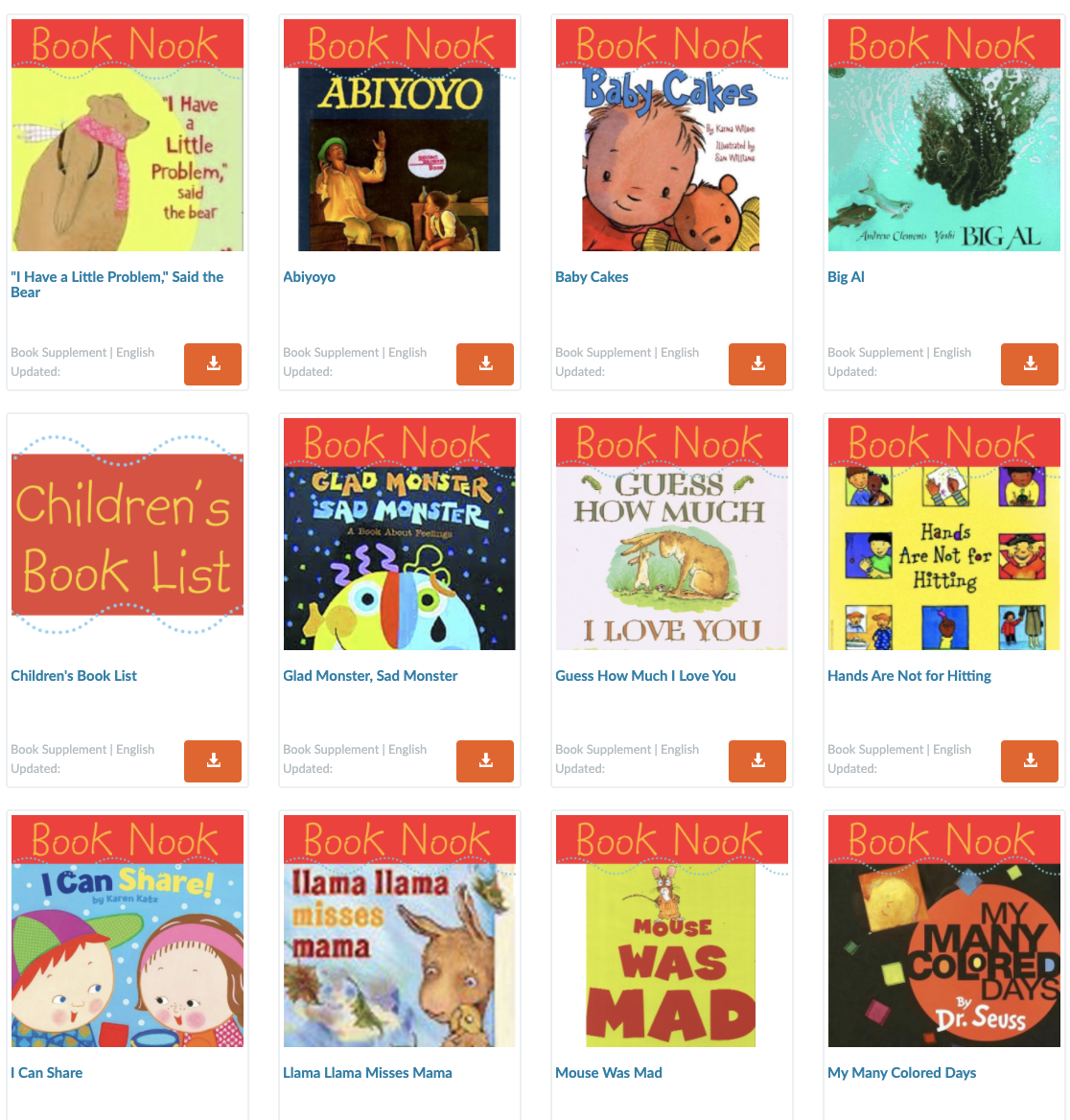
Book Nook
There are many popular books that can be read to children to support social emotional development and teach them about various emotions and responses to life’s daily events.
Each book has a lesson or activity that is relayed in a positive and engaging manner with hands-on ways to embed social emotional skill building activities into everyday routines.
Check out this comprehensive children’s book list to teach about cultivating relationships and enhance positive behavior.
Keep in touch with student emotions
There are countless visual tools to monitor or express how one is feeling emotionally. From feeling wheels or faces to charts, to greeting boards, to bulletin board mood meters samples, teachers can be in touch with the mood of their students. More importantly, this helps the students gain the awareness to be in touch with their own feelings. These concepts are effective from toddlers to teens and help build community in the classroom.
Resolve conflict creatively
Once students understand their emotions, they can progress to conflict resolution.
There are additional videos to help teachers guide their students in conflict resolution.
Coping and calming strategies with sentence starters are also effective ways to help children practice expressing empathy and feelings in daily situations. In the classroom, creating creative, peaceful and calming corners works for some students.
By modeling these strategies for students, teachers can help inspire social emotional learning and help students thrive in learning whether it’s in the classroom or remote.
We recently welcomed Megan Hoffman, LCSW and Emily Crane, MEd from the Compass Health Center to present to ATT teachers about how to support day school families as their children’s needs change dramatically this year, sometimes on a daily basis.
Our job as teachers and as the ATT is to help students thrive. As part of that, we are working hard to implement tools and strategies to promote positive mental health.
When the pandemic first started, this sentiment resonated with a lot people: “We are in the same storm, not the same boat.” When we consider the disparities among how equipped families are to deal with the ramifications of this time, it’s clear that each family and individual continues to experience it differently.
Mental health anguish can often feel like a flood of very complex emotions. When the biblical flood threatened the world, Noach built an ark to keep life moving forward. Now it’s our job to teach our children how to build an ark. Only this time instead of gopher wood, we have tools from organizations like Compass to help students thrive in the most challenging circumstances.
Impact of COVID-19 on mental health in uncertain times
Trauma, grief and loss all have respective psychological, behavioral, social and physical reactions. Everyone has lost something due to the pandemic, and the grief is personal and specific to each individual. This loss could look like a loss of a loved one, loss of connection with school, peers and participation in cherished activities.
Some may experience the loss of routine, safety and certainty of what will happen in the future. The combination of these losses can lead to a loss of personal identity and new or intensified mental health struggles.
Educators are also experiencing these losses and are learning how to support their students and colleagues through grief. It’s even more crucial now to normalize and allow a safe space for others to talk about emotions. It’s not always possible, but humor or a silver lining can be healing.
Once the losses of the pandemic are validated, the Kubler-Ross model of the Five Stages of Grief can be a helpful guide for understanding what students are feeling. Some students may feel shock, denial, frustration and depression at times. Students will benefit greatly from having a teacher that is able to help them navigate these emotional waves.
Emphasis on emotions
Developing and expanding emotional vocabulary is a helpful way to cope with difficult situations. Knowing our emotions helps us get our needs met, in other words, “If you name it, you can tame it.”
A great starting point is recognizing that feelings are not facts. There are resources such as Lindsay Braman’s emotion-sensation wheel to expand emotion vocabulary. This method works by giving students the vocabulary to be able to share their feelings more comfortably. Once an emotion is identified, the teacher can ask the student if they can think of anything that would help in this situation.
Teachers should have a chart or graphic with faces of various emotions easily accessible in the classroom to help a student feel more comfortable when asked, “How are you feeling today?” This allows students to separate themselves from the emotion. Oftentimes, emotions pass and this method helps students move through the emotions more smoothly.
Stress and distress reactions
Pain is unavoidable at times, and teaching acceptance around what cannot be controlled may help students avoid unhealthy coping mechanisms. Teachers can work with students on a personal “stress survival guide” to help them nourish their body, mind and soul.
For the body, encourage students to get enough sleep, exercise, eat well, practice deep breathing, listen to calming music, etc. To help put their minds at ease, encourage talking about their stressors, have them keep a journal, learn to prioritize time, and set healthy habits and rituals. Engaging in positive self-talk, taking a break from social media, accepting stress as normal, trying mindfulness and finding ways to relax are all ways to help nourish the soul and keep from getting burnt out.
Though a certain level of anxiety during stressful times is normal, there are indications when additional help might be needed.
Here are some stress and distress reactions to watch out for:
Significant changes in sleep patterns
Increase in physical/somatic symptoms
Increased irritability, increased distractibility
Increase in isolation and avoidance
Decreased sense of safety
Increase in frequency and intensity of worries
Avoidance of fears
Engaging in excessive reassurance-seeking behaviors
Major shifts in mood or activity levels
Talk of suicide or self-harm
Substance use
Intrusive thoughts about Covid that are impairing
Mental health in the classroom
To promote healthy mental health in the classroom, it’s important to manage expectations versus reality around school. This can be achieved by normalizing the range of reactions and creating a space for students to talk about how their year is going.
One way to begin this dialogue is to ask students if they have questions or concerns about the future and uncertainty. In this conversation, it’s appropriate to say, “I don’t know” when there aren’t clear answers which can actually help validate fears around uncertainty, feelings of isolation and loneliness.
It’s important to master and then teach students how to hold the dialectic, or find the balance between acceptance and change. This inspires students to identify what is in their control and what is beyond. Mindfulness strategies and emotional regulation can help with this.
By taking some time to enhance classroom management strategies, educators can work towards helping students thrive despite the present challenges. Teachers can implement morning meetings, have break-out groups on Zoom, have one-on-one check-ins with students to see what is going well and what needs some work.
Having the students participate in these ways can help create accountability in students. It may also be helpful to use games in the classroom as a way to creatively combine learning with some much-needed entertainment and unwinding.
Ways to help students cope
Encourage boundaries – Maintaining proper boundaries is even more important with social distance and virtual learning. Kids and adults are both feeling overwhelmed with connecting with others via technology, and it’s necessary to have proper boundaries in place to be able to “turn-off.” Identify consistency and availability within the context of boundaries.
Teachers should encourage self-care. One creative way to help students with this is by playing “Self-care BINGO” and have categories like reading, being kind, creative activity, dancing, playing outside, etc. Teachers can start by creating their own self-care board and show clear boundaries on food or technology to model a sense of balance.
Validating vs. fixing- It’s imperative to distinguish between validating problems and fixing them. Validation doesn’t mean there aren’t expectations or consequences and the behavior should be redirected if inappropriate. Although it feels natural to want to help someone by finding a solution to their problems, sometimes all they need is to be told, “I hear you, but we need to move forward” and discuss it another time if it remains a problem.
Consistency, predictability and uncertainty – Schedules and routines when possible help students stay grounded when so much around them is uncertain. There should be a clear understanding of expectations, rewards and consequences and students should be guided toward finding the delicate balance between consistency and flexibility.
Even if they don’t know where the river is headed, they should know what the boundaries of the river beds are. When a teacher practices acceptance around not knowing, students can learn that uncertainty is a part of daily life. Teachers cannot predict the future, but they can help students learn how to cope and FACE COVID.
Focus on what is in your control Acknowledge your thoughts and feelings Come back into your body Engage in what you are doing
Committed action (engage in our values) Open up Values Identify resources Disinfect and distance
4 mental health boosts for students
Radical acceptance
Identifying what is within our control and what is not means having students ask themselves, “What am I the boss of?” By teaching students that they don’t have to like what is happening but accepting reality can help them cope with life’s uncertainties.
Remember – Pain + non-acceptance = suffering.
Grounding techniques
Use this while radically accepting to get students through difficult moments. Grounding exercises include: taking a break, petting your pet, 4×4 breathing exercises, using the 5 senses to get the mind off of it, using fidgets. Teachers can have students identify their own coping tools. Youtube has many videos on breathing exercises that can help students in stressful moments. The book Alphabreaths:The ABCs of Mindful Breathing and other similar books help kids get through stress.
Gratitude
Teach students through exercises to bring their awareness and attention to what they are grateful for. Ask students to name just one thing we are grateful for this week, as a class, as a community? Even on Zoom the chat feature can be used for this type of exercise.
Goals and motivation
Setting and striving towards a goal is a great tool to boost mental health. Teachers can use goal-setting in the classroom or during remote learning. Once the goal is set, work with the students on how to gradually achieve it by breaking it into smaller steps, establish clear expectations and encourage motivation.
Keep in mind, it’s impossible to implement every single new technique and expand emotional awareness overnight. Gradually adding in some of these elements to already planned lessons and being more mindful going forward will help teachers help their students grow and thrive.
The need to assess students’ knowledge is vital to enhancing teaching and learning. But with so much disruption to the school year last year, assessments this fall 2020 are even more important than usual. In order to prepare for the school year, ATT teachers attended a workshop with Rabbi Dr. Dovid Jacobson, Educational Consultant, Yeshiva Educational Services, Inc., about the types of assessments they can use.
There are 4 types of student assessments:
Placement testing: a pre-assessment before instruction begins. This creates a baseline for instruction.
Formative assessment: done by the teacher at the beginning and during instruction to note students’ progress and check for understanding. This is not necessarily for a grade, it is to help the teacher assess the progress of the learning.
Diagnostic testing: used to figure out if there is an impediment to learning so that the teacher can make accommodations or provide extra resources.
Summative assessment: tests at the end of a chapter, unit, year, course for purpose of giving a grade or advancement to next level of learning and to collect data on the student progress.
Placement testing and formative assessment are used to assess readiness, and teachers might need to adjust their teaching accordingly. This is always important, but it’s more important this year since students have not been in the traditional classroom since March.
Once you have your assessment results, you’ll need to
Revisit the plan for the course/unit/lesson and make adjustments as needed.
Provide or seek support for students who are below (and above!) level,
Implement differentiated instruction based on student needs
This year it’s essential that teachers focus on ways to make remote learning interesting and effective. Now’s the time to make a habit of finding ways to make virtual learning interesting and interactive, as some students in the ATT system have opted to learn from home this year and others have to stay home even for a slight cold. Plus, there’s the realistic possibility that some classes or schools will have to learn remotely at times this year.
To help provide teachers gain the tools necessary to make this unusual year successful, the ATT is offering teachers additional professional development opportunities. Recently, education consultant Lakey Silber met with teachers over Zoom to explore creative ways to make virtual learning exciting for students.
Practice using the virtual whiteboard whether it’s in-person or virtual
With the many types of different learners out there, having a visual component to any lesson can be both engaging and essential for some students. Take the time to practice on your own and with your students by writing your name, drawing, coloring and using the different tools offered.
Here are a few ways to use the whiteboard to make learning engaging:
Hangman – Take turns coming up with the word the students guess and having students submit words to use.
Pictionary – A fusion of words and pictures can be both fun and educational for students.
I packed my bags to Israel – “And in it I put…” Followed by an object and the next student repeating the original object along with an addition.
Picture by piece – Draw one partof a picture at a time and have the students copy each part. At the end, share the picture with the class.
Alphabet four squares – A name, place, animal, think in four squares
BINGO
Shared screen
Having access to a screen sharing feature offers many creative learning opportunities for the virtual classroom. Games such as Boggle, Scattergories and Secret Code can all be used while screen sharing. Putting up a maze on your screen allows the students to simultaneously journey to the completion together.
Sharing your screen can also be an engaging way to read a story together as a class. Read the story on slides so that the text and pictures are clear and vibrant to students. Screen sharing also allows the students to participate in a show and tell virtual experience.
More activities to use with a shared screen include:
I spy
Word find
What is missing
Can you guess the sound
Show a part of an object and the students guess what it is
Memory game
Scavenger hunt
Dots and boxes
Find the hidden objects in the picture
There are enough options that you can incorporate many of these activities into daily lessons and see what works best with your class for the future.
Effectively playing games
Learning games are a tried and true method of teaching, and remote learning affords teachers many opportunities to incorporate fun and educational games into the mix.
Triviamaker.com has different game modes to make quizzing students on materials fun, social and engaging. Similarly, teachers can use Family Feud, multiple-choice activities or other trivia games. Powerpoint and other software enable teachers to easily create Jeopardy-style games to quiz students’ knowledge.
The picture story game is a very engaging and thoughtful exercise to do with students. For the game, each student receives a picture. Then, one student begins the story and each student continues the story with their individual picture.
Another option is to play “Last Letter.” To play, the teacher selects a category for the game. The first player names a word in that category. Then the next person names a word in that category that starts with the last letter of the previous word the person said. The game continues until everyone is stumped.
Art projects for virtual learning
Participating in arts and crafts projects is proven to reduce anxiety, and in a time of such uncertainty, students will certainly appreciate the change of pace. The projects don’t need to be so complicated either. Make a flying paper airplane, paper boat or a simple paper plate project like a smiling sun. Teachers can have the students draw a picture and cut it out to create their own puzzle.
Movement and exercise
With remote learning, the thought of sitting and staring at a screen for hours can be daunting for even the most patient students. Break up the learning with some movement and exercises as often as needed. Play “Simon Says,” and teachers can give students the opportunity to play “Simon.”
Freeze dance is a great way to incorporate music and energy into the learning experience. Put on music and let the students dance until it stops. Students can also dance with an object like a broom or a scarf to make it more interactive.
“5,4,3,2,1” is an exercise where the teacher proposes five different movements in descending order. Five jumping jacks, four spins around, three hops on one foot, two walks around the room and one high-five for a friend.
Movement and exercise can also mean using the time for relaxation and focus techniques. Practice breathing strategies with students such as smell the flower and blow the pinwheel. Have students breathe in while raising their hands and breathe out slowly putting their hands back down. Giving students clapping rhythms to copy or providing Youtube videos such as JJ Duchman’s “Keep School Fun” are also creative ways to keep students engaged.
Although nothing can replace the power of in-person learning, using creative and engaging activities can make the best of the virtual learning situation and give students a positive experience when they need it most.
There is hardly an area of our lives that is unaffected by the pandemic. It has brought uncertainty, anxiety and isolation. For students even under normal circumstances, sitting and learning can be difficult. With the pandemic, the potential roadblocks to education are that much harder to break through.
As ATT teachers launch this unusual school year, we are offering several professional development sessions to support them. Sarah Steinberg, MS, BCBA of Steinberg Behavior Solutions and Jill Hollederer, MA, BCBA met with teachers over Zoom to provide tools for transitioning to learning in-person.
Although we are fortunate to have programs such as Zoom and Google Classroom, learning remotely presents many added challenges to students. In the physical classroom, there are distractions, but the energy of having a teacher and other students often helps students focus and stay accountable.
It’s also important to approach education with a balance in striving for meaningful learning during the pandemic as well as emphasizing emotional support for students. Fortunately, there are tools and techniques to help students adjust back to in-classroom learning and thrive in this unusual school year.
Set goals and expectations
The first step in helping students acclimate back to learning in the classroom is for teachers to identify the specific needs of their students. Teachers will then be able to offer personalized support throughout the transition.
Teachers can ask students to reflect on both the challenges and benefits of remote learning. Teachers may find that students prefer certain elements of the remote learning experience, and they can work towards implementing those strategies. This also has the potential of addressing some of the emotions students might be feeling and can be a helpful way for them to cope.
Setting clear classroom expectations will provide students with knowledge and understanding to reduce uncertainty. This increases the students’ willingness to comply with new behaviors.
Here are some helpful tips on how to set solid expectations for in-person learning in 2020:
Present what students can do rather than what they can’t do
Stating rules and expectations in the positive encourages students’ compliance and also makes it easier for the teacher to enforce. Rather than telling a student what not to do over and over again, reframing a command in the positive creates a more nurturing environment and better promotes meaningful learning.
For example, instead of writing a class rule stating, “Don’t get out of your seat without permission,” write, “Please remain in your seat until you are given permission.” It’s a slight change that makes a big difference. Another example of a class rule in the positive is “We are respectful.” Under the rule, you can elaborate on the practical applications such as, “Listen to the teacher and your peers, speak kindly and respect personal space.”
Offer choices
Many students respond better when offered a choice between different options. This gives them responsibility and some level of control. Teachers can give the students an option to use hand sanitizer or wash their hands, to choose the schedule of activities or actually help create the guidelines for the class (with some guidance, of course.)
There are many areas that teachers and students are not able to be flexible in the classroom, but finding an area with flexibility and offering choices to students will help encourage participation and even excitement in regard to classroom activities.
Use reinforcement charts and praise students
Now that the guidelines are in place, reward students for following them through some form of reinforcement. Teachers can use a sticker chart, participation dollars or another creative option as a reward. Teachers can ask students what reward is best for both short-term and long-term reinforcements to help motivate them.
Clearly and visibly display the expectations
Create an appealing poster or graphic to display the expected behaviors to earn the reinforcer, how the teacher will check, what the reward will be and when it will be given. Try to only present what is relevant for the students today in the short-term. The long-term plan for fading out the reinforcement will come gradually as students are more adjusted back to in-person learning.
Look out for behavioral concerns
Students often display troubling behavior when going through a challenging time, so it’s important to identify what these possible behavior challenges are and how to best work through them.
Some examples of COVID-19 related behavioral concerns might include:
Struggling to wear a mask especially for long periods of time
Washing hands frequently or overusing hand sanitizer
Restlessness
Difficulty focusing
Hypersensitivity
Aversion to certain fabrics
Hyperactivity
For a student who is exhibiting challenging behaviors, try offering choices, offering extra assistance and allowing additional time for them to complete tasks. This will help with students who need to build up skills potentially lost from the lack of in-classroom learning which may be a factor in their acting out. To limit the over-use of hand sanitizer or handwashing, make sure to plan frequent times for both so the students can expect when they will be able to eliminate germs.
Allowing the use of noise-canceling headphones, separating workspaces or having students work in small groups are all helpful ways to channel both hyperactivity and difficulty focusing. Making sure to use reinforcement rewards and specific verbal praise will also motivate students in the classroom.
When the expectations and reinforcements are at the forefront of the students’ minds throughout the day, they will be more likely to exhibit positive behaviors. Reminding students before recess or social activities can help encourage positive interactions between students and their peers. As the teacher models following the rules and expectations, great emphasis should be placed on praising students who are serving as role models for their peers.
Be mindful of sensory issues related to COVID-19
Sensory issues related to COVID-19 might be anything that affects the senses such as touch, sound, taste, smell and sight. A recommended technique to help students cope with this challenge is systematic desensitization. This will vary depending on the sensory need, but examples include gradually increasing the duration, offer choices, provide scents in their masks and to encourage frequent breaks in the bathroom or plexiglass corner.
Students who may be slightly more sensory can have a hard time wearing masks, especially those made out of certain fabrics. Work with the parents to find a mask that may be more comfortable and manageable.
The four main motivations behind behavior are:
Sensory challenges
Escape or avoidance
Attention seeking
Tangible (to get something a student wants)
By taking the time to really listen to what the students are going through and what they could benefit from, teachers can work towards more meaningful, effective and engaging learning in the classroom.
On Rosh Hashana we will be saying the famous prayer of Avinu Malkeinu (Our Father our King).These words have a powerful meaning which can be understood through the following story that I heard from Rabbi YY Jacobson (Founder and Dean of TheYeshiva.net).
There once was a rabbi that specialized in working with at risk youth. He worked tirelessly to reach out to these young adults and connected with them in many ways to bring them back to the way of Torah. One day a tragedy struck in his home and his youngest child took ill and passed away suddenly. As he was sitting shiva, a group of these boys walked in to pay a shiva call. The leader of the group made a pledge on behalf of the group and said the following, “Rabbi, you have done so much for us and we are grateful to you. To show our appreciation, we have accepted upon ourselves to observe this coming Shabbos in memory of your son.” This group of boys had not kept Shabbos in years. The rabbi was touched and sincerely thanked them for this gesture.
As the boys left, people commented, “Really!! Is that all they could do for you after all you have done for them. Just one Shabbos – they should accept much more than that.”
The rabbi said, “You don’t get it. Think about what one Shabbos means. Do you know what I would give to have my son alive for one more Shabbos? To walk to shul together, to bless him, to tuck him in his bed at night, to watch him play, etc. You can’t minimize what that represents.” These words alone would have been enough of a rebuke, but the rabbi went one step further and continued, “Think about G-d and how HE feels about his children, to have then at HIS table for one Shabbos, how precious that must be to HIM.“
The rabbi didn’t focus on what it meant to him personally, but to Our Father in Heaven. This rabbi understood Avinu Malkeinu, G-d is our Father and we are all His children. Let us all keep that in mind as we approach the New Year and pray for all of His children to be together at His table once again with the coming of Moshiach in our times .
During the ongoing COVID-19 pandemic, the ATT joins the great number of organizations and agencies who are working diligently to mitigate the impact of this unprecedented event. As humanity struggles with fear, loss and uncertainty, we are buoyed by our faith and our commitment to each other. The Navi Yeshayahu tells us “אִישׁ אֶת רֵעֵהוּ יַעְזֹרוּ וּלְאָחִיו יֹאמַר חֲזָק – Each man shall assist and encourage his fellowman.” This has become the response of all people of goodwill and compassion, and we are grateful to the volunteers, dedicated lay people, leaders and community servants who continue their daily service to the community with compassion and dedication under trying circumstances. May Hashem repay them with good health and the fulfillment of everything good that they need.
Community-wide contact tracing
The ATT schools have all prepared contingencies for the event that a staff member or student is positive for COVID or has been exposed to someone who tested positive. The schools are mandated to report any outbreaks to the local health department and to receive guidance regarding quarantine and contact tracing procedures.
As our schools are an integral part of our community’s infrastructure, we want to encourage the parents and staff of our schools to participate in the communal tracking endeavors which will help our community leaders have more focused and accurate information. Data on COVID which is shared about the general population is not as helpful as information that is generated within the community as it helps us get a true picture of how the community is faring in preventing the spread of COVID. There two platforms that are available to report cases of COVID, Community Counter and COJENT.
The ATT would like to thank the JUF for advancing allocations to all our day schools during this challenging time. The JUF staff have been spending countless hours on ways to provide much needed assistance for agencies throughout the Jewish community at large. We thank all the professionals that are working diligently to meet these needs and may G-d grant all of you the wisdom and strength to make the best decisions on behalf of our community.
The ATT wishes to give a special acknowledgement to the Kehillah Fund and the Walder Foundation for the special emergency grant it has provided to the community’s schools. This will help the schools defray some of the costs of all of the emergency infrastructure that needed to be created on short notice as well as substantial shortfalls in fundraising and other revenue shortfalls. We wish you and yours the best of health and we all pray for a speedy resolution to the current situation.
Here’s how the ATT is doing to support its schools and the community at large.
1. Guidance and Policy:
Helping the school community make decisions and to craft policies in response to the unusual circumstances created by the pandemic
Consultation with school leaders to help them meet challenges and needs
2. Technology Resources, Training and Support:
Helping schools find financial and training resources to maintain continuity of learning
Supporting individual teachers with technology and methodology needs
Convening ATT’s Principals Council to collaborate
3. Advocacy to Public and Private Funders:
Identifying the scope of school needs and working with governmental bodies and nonpublic funders to meet those needs
Assist schools to access Federal Payroll Protection Loans (PPP) to assure that staff will continue to remain employed
Assuring that remote learning requests are eligible for Title I funds.
Consultation with Chicago Public Schools and four other public school districts to access the Federal CARES Act/Education Stabilization Fund and understanding appropriate uses of the funds. These consultations consist of the exchange of information and monitoring that our schools are getting their fair share.
Assuring that remote learning requests are eligible for Title I funds.
Successful efforts with Chicago Public Schools to reinstate IDEA Proportionate Share special education services for eligible students so that services could resume remotely. These services include speech, LD learning specialists and other LD interventions.
Managing the required paperwork for Federal Title programs and tracking their progress for payment.
4. Family Support:
Ongoing parent support sessions to help them be effective and supportive of their families during this crisis
Individual referrals and supports
Resource lists for families to keep children well occupied
5. Partnering with other agencies and organizations:
Helping to coordinate and craft the communal responses to the evolving needs of the times for maximum efficacy
6. Supporting Special Needs:
REACH is continuing its special services to students remotely
Helping mainstream teachers teach effectively to students with varied abilities
7. Mental Health Needs:
Providing networking and resources to school social workers and families
Monitoring trends to address mental health needs proactively
Social Work Sessions
Immediately upon the closure of schools, we gathered social workers from several ATT schools together for a public Zoom session with parents, followed by second session on March 26 and another one on May 11.
March 15 Session
March 26 Session
May 11 Session
Peer Tutoring
We are setting up peer tutoring and chavrusas for students interested in finding a learning buddy or mentor in limudi kodesh and limudi chol subjects. Complete the survey here If your children would like to participate.
REACH’s expert in Collaborative Problem Solving (CPS) Tamar Shames spoke on March 29 on Facebook Live and Zoom, offering tips for this challenging time from this research-based behavior method that the use to train teachers. CPS can help you work with your child to build up their intrinsic motivation to make positive choices and solve problems.
We are constantly updating a full list of homeschool resources in Judaic and general studies here. We encourage you to check the website links out for yourself and to supervise children while using the web.
As relieved as exhausted parents are to be sending kids back to class this school year, this comes with concerns and challenges. Beyond health and safety, parents, kids and schools alike are all wondering about connecting during this time of wearing masks and social distancing. And for those families opting to keep children home for remote learning, the need to find creative ways of connection is even more crucial.
Rabbi Ephraim Hochberg of YTT and ATT’s Rabbi Avrohom Moller addressed educators from across the ATT system to discuss ways to proactively pursue a relationship with each student.
Relating to students as a teacher or rebbe is always a key factor in learning and in helping kids have a positive association with school. The concern that we could revert back to remote learning makes building relationships early on even more critical.
Two prerequisites of relationships
Any strong relationship between a student and teacher is based upon safety and trust. Only once these conditions are met, can a teacher move on to build the relationship.
Creating a safe space for learning:
A teacher has a responsibility to make sure his classroom is safe, everyone is respected and has a role and everyone will be defended against bullying and other aggression. This means a teacher has to be empathic and really try to understand the child’s perspective. He has to be authentic and open rather than aloof and controlling. A teacher should never use sarcasm because many kids cannot process it.
A classroom feels safe when learning and the schedule are predictable and clear
The teacher is consistent, cheerful and fair
A teacher can admit when she makes a mistake to establish safety and trust
A teacher can be vulnerable and show that he is also human
To build trust, a teacher must listen well and be there for students when they need problems solved. It means to forgive and forget without bearing a grudge. Trust happens when a teacher spends time thinking about solutions for a child’s challenges and gets back to him. Teachers who demonstrate trust will have students who reflect it back. It’s a tall order, but this is all the job of an educator.
Building the relationship with students:
Connecting with students takes effort. In the beginning, it can be as simple as using a child’s correct name and spelling. Or it can be something specifically personal for a student who needs it (e.g. a coin for student’s collection).
Teachers have to be masters of offering genuine and specific praise. They have to tout a child’s achievements to others, including their parents and grandparents. They have to notice what students need even if they haven’t asked for help.
Most importantly a child should feel that her teacher is happy to have him in class.
In Parshas Ki Seitzei, the Torah tells us that when a man marries, he is exempted from military duty and other communal responsibilities for the first year. The Sefer HaChinuch explains that the intent of this mitzvah is that the young couple will be able to cement their relationship and that investing focus and time will help build that strong foundation required for a stable and happy relationship.
I am departing from my usual parsha message style and addressing the current school situation in particular.
School is in the air! Reopening is happening this week, G-d willing, for most of our schools!! The ATT schools have been working diligently throughout the summer to plan for in-person learning in the fall while being vigilant about the community’s health concerns. Schools are working overtime to comply with the government requirements for safe school reopening and consulting with their medical advisors to add additional layers of safeguards to assure the greatest measure of safety possible. Schools have used creativity and a “can do” attitude to overcome major hurdles and logistical problems to reach this point. Some schools have allocated sizable budgets to enlarging classrooms, creating useable outdoor space such as tents, purchasing screens and partitions and providing viable options for families and teachers who cannot reenter school safely at this time.
The ATT has been working with the schools in helping them plan, share information, and advocate with outside entities who can help. We are helping the system’s teachers be prepared and to feel confident and positive about the new school year with all of its unknowns.
The schools have also done a great deal to make sure that their planning is transparent and clear to the parents. Schools endeavor to accommodate the special needs of families and students who may need to maintain a higher level of separation and are doing a remarkable job within the constraints of what is possible. Please continue to work with your child’s school while recognizing the difficulties we are all facing and the limits that this pandemic has placed upon us all. This period has been very taxing, and the best way forward is to work together.
The best way to prepare your child is to be positive about school reopening while acknowledging the hardships and uncertainty which come along with it. We are going to do this and focusing on the positive will make this journey easier. A good attitude about these challenges will strengthen our resilience, adaptability and perseverance.
A lot is hinging on our schools’ and parents’ efforts. We should all daven that our efforts are blessed with success.
Getting back to school safely this year will require all of us to be on board with masks
When it comes to getting kids to wear masks to school this year, they can look to so many professionals who wear masks all the time already. Policemen, firemen, construction workers, doctors, nurses, scientists and the list goes on of jobs that require masks. Reminding kids of this is just one of the ways to inspire them to wear their masks with pride.
Masks have become part of the new normal to keep yourself and others safe, but school will likely be the first time your child has to wear a mask for so many consecutive hours.
There are ways to make this more manageable and maybe even a little fun for kids. Though kids are often more adaptable than we adults anticipate, it can still be hard for children to comprehend why it’s so important to wear masks, and it can be even harder to actually keep them on.
Why we wear masks
It’s important to explain to your kids just a little bit of the science behind wearing masks so that they can relate to the importance of wearing them. The more children understand why they need to wear masks, the more willing they will be to actually wear them.
For starters, the CDC says, “COVID-19 spreads mainly from person to person through respiratory droplets produced when an infected person coughs, sneezes, talks, or raises their voice. These droplets can land in the mouths or noses of people who are nearby or possibly be inhaled into the lungs.”
The candle test
One effective and engaging way to get a kid’s attention is a fun science experiment. Bill Nye recorded his experiment where he attempts to blow out a candle wearing different face coverings. He starts with a scarf wrapped around his face and successfully blows out the candle. In another attempt, he attempts to blow out the candle wearing a cloth face mask and is unable to extinguish the flame.
Although this cannot necessarily prove that the mask you are using is effective in containing droplets, it is a fun experiment to do with children to show them what the mask is supposed to do. If your child can easily blow out the candle, it is probably a good indication that you should get a different mask.
Get kids involved to wear masks at school
Another great way to encourage your child to actually wear his or her mask is to have them involved in the selection process.
Sit down on Amazon or any other website and peruse masks together or print a selection for them to review.
There are also DIY masks that you can create as a project together as a family.
Grab some iron-on decals or stickers and let your child decorate their own mask that they will be excited to wear. Check your school’s guidelines to see what kind of rules your schools has for masks.
As you get your children involved, make sure that you do your best to model mask-wearing in front of them. When you leave for a store, proudly exclaim that you have your mask ready-to-go. Positive reinforcement can go a long way, so when you see your child wearing his or her mask make sure to praise them and highlight the positive behavior.
Practice makes progress for wearing masks
In some ways it seems like the pandemic has lasted forever, but wearing masks is just one of the many aspects that will take some time to get used to. To make it easier, here are some ways to practice mask-wearing with your kids:
Practice for short periods of time: Wearing masks takes time to get used to. No one enjoys the feeling of not being able to breathe, especially when it’s still 80 degrees outside. By allowing your child to wear the mask for five-minute increments and gradually increasing the time, you can allow them to get used to wearing their masks for a longer time at school.
Make it fun: Depending on the age of your child, making a game around mask-wearing could be an effective tool. Introduce masks in playtime by playing doctor, putting masks on stuffed animals, or make it a race to get it on. This will also help ensure that your child can take their mask on and off without assistance. By making mask-wearing fun, you are both encouraging them to successfully keep their mask on at school and also keeping the mood a little lighter.
Delivering the message: Little reminders throughout the day about the importance of mask-wearing can help them become accustomed to wearing their masks. You know your child best and what interests them, so try to find a way to address mask-wearing in a way they will be receptive to.
Have extra masks handy
Wearing masks may be uncomfortable at times, but it doesn’t have to be stressful. When you find a mask you like, buy extra so that you can keep spare ones in the car, their backpack, and by the front door for easy access. Start with a few masks from different stores to see what styles your kids like best. Masks fit differently depending on each person’s size and facial structure, so what works for one family member may not be ideal for another.
Finding the right mask for your child to wear at school
Don’t settle for a mask that falls off or is uncomfortable to wear. There are some great masks out there that are easy to wear and breathable, but still provide adequate protection for you and your child. Here are a few top picks for the best masks to start the new school year:
It may be worth the CostCo membership just for these masks. They are light, breathable and though they are easy to put on, they don’t fall off easily. They are also machine washable and come in an 8-pack so you can keep up with having a clean mask for school each day. They come in a variety of solid colors, vibrant and neutral, and even pass Bill Nye’s “candle test.” They also have the mask for adults to match.
These are your standard rectangle-shaped mask in a variety of colors and designs. They are also machine washable and have a metal nose clip to help the mask stay on better.
This mask gives you the option to add filters for extra protection and also contain the nose wire. These handmade masks are lightweight, breathable and also have adjustable ear straps.
While you are doing some back to school shopping there, Old Navy’s masks come in a variety of solid colors, are breathable and are easy to take on and off.
Target’s face masks are soft, comfortable and one size fits most kids three and up. These masks include the nose wire, have two layers and a pocket for a filter (not included.)
A few more notes to consider when buying masks for this year:
It is a good idea to buy several styles of comfortable masks so that your child can choose what works best for them.
Masks with nose wires often work better for children who wear glasses. If you use a mask with a filter pocket but no nose wire, you can repurpose a blue medical mask that has a nose wire in it, just trim it to size and insert it into the pocket.
Some people experience dryness after prolonged mask use. Check that your child has access to drinking water throughout the day.
This school year brings with it many unknowns and challenges, but by taking proactive measures we can make mask-wearing just a little easier and more effective for our kids and teachers to have a safe and successful school year.
Note that the ATT is not a source of medical advice, and you should ask your pediatrician if you have any questions about the safety of any particular masks.